 Hexathlon
Cover image courtesy of Dreampace
Go online and type in "Running age grade calculator" and you will find a number of tools available to help calculate an age grade % score for your performance, and in all likelihood they will all give you a different number. In fact when researching age grading whilst setting up Hexathlon, we discovered the number can range considerably depending on which calculator you use, especially for older athletes. So why is that and which one is right? And how do we ensure that Hexathlon provides fair comparison across age groups and genders?
How is age grade % calculated?
To answer the questions posed above first we need to understand what the concept of age grading is and how it is fundamentally calculated.
In 1989 the World Association of Veteran Athletes (WAVA) - now known as World Masters Athletics (WMA) - produced a set of tables for grading athletic performance using formulae based on age and sex. Essentially the formulae produce an age factor that you can then apply to the "open standard" (the world record for a senior athlete between 18 and 35 years old) to predict the equivalent best performance for an athlete of a non-open age.
So two things are key to know:
The open standard (world record) - which is a dynamic variable
The age factor
World records are continuously progressing, so in effect the open standard is always dropping. So this is the first reason why some calculators will produce a different number - it depends on what open standard they are using. Hexathlon is using the world records as of Jan 1st 2026.
Distance | Male WR (as of Jan 1st 2026) | Women WR (as of Jan 1st 2026) |
|---|---|---|
5km road | 12:49 | 13:54 |
10km road | 26:31 | 28:46 |
Half Marathon | 57:30 | 62:52 |
Marathon | 2:00:35 | 2:15:50 |
Second is the age factor - since 1989 many running/athletics enthusiasts have worked with governing bodies to refine these age factor numbers. Two of the leading researchers into developing age factors and how performance changes as we age are Alan Jones and Howard Grubb. The British Masters Athletic Federation, World Masters Athletics and USA Track and Field have used their findings to help produce their own age factors. Howard's own website has some interesting reading and graphs detailing the research he has done along with other academics on the subject. Check it out here. To develop the age factors, analysis of athlete's times over a range of distances and ages was done. Interpretation of their findings show that, due to muscular atrophy and physiological changes, speed and power reduce as we age, but the decline is more pronounced over shorter distances compared to the longer distances. It was found that performance declines fairly linearly up until the age of 80 and then the rate at which speed declines accelerates, dropping off more quickly for women than men.
The WMA's latest age factors were published in 2023 incorporating this trend and which you can check out here. Currently they are the age factors that Hexathlon has adopted.
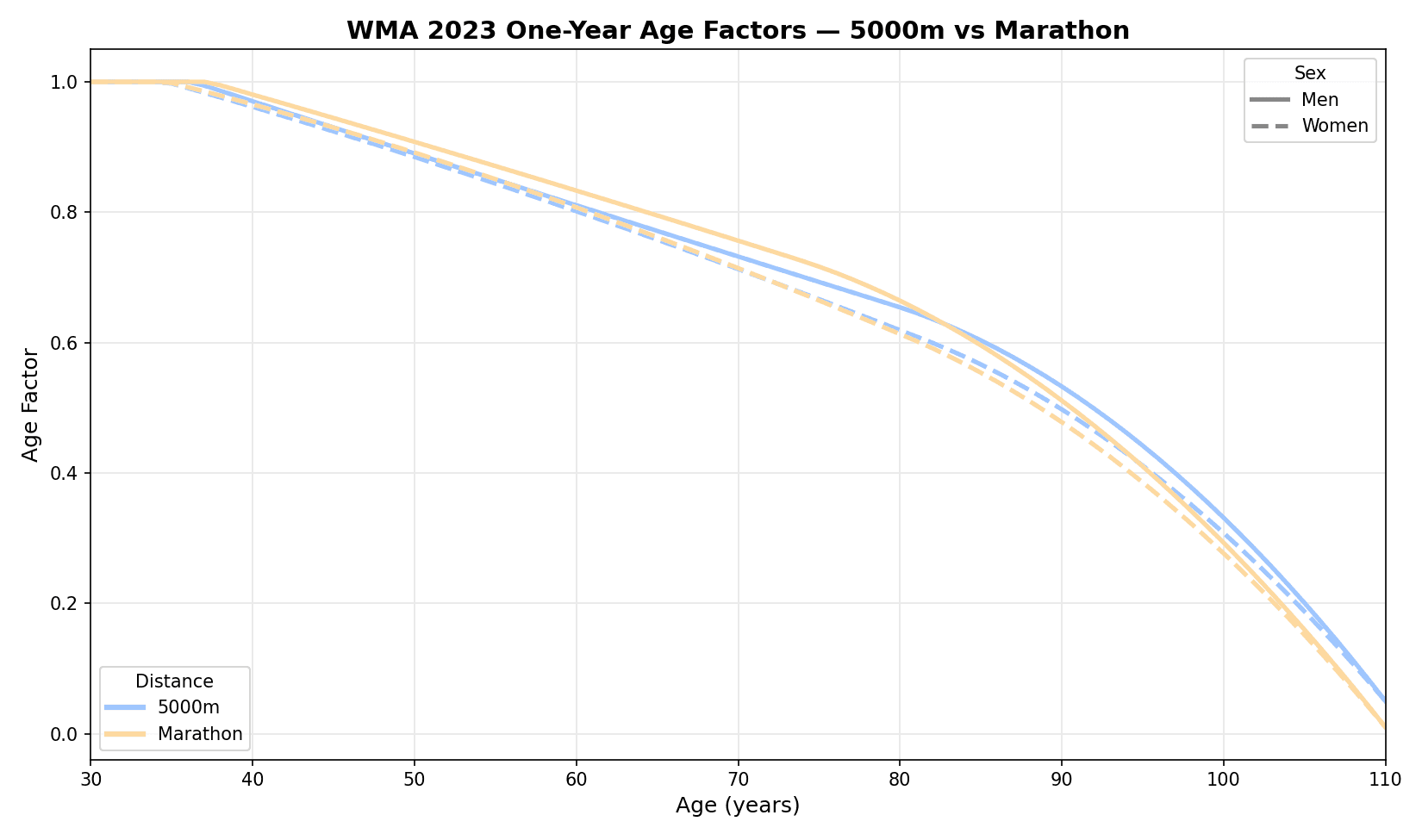
You can see from the graph that the age factor drops off linearly from 35 to around 80 and then begins to accelerate decline, sharply dropping off from 85 onwards. You can see that the age factor for the marathon maintains a higher age factor than the 5k through most of the masters range (up to around age 83), especially for men, reflecting the lesser premium on raw speed over longer distances. At the oldest ages, when running speed generally equals out over all longer distances, the two converge and cross over - reflecting the difficulty in length of event once again.
There is some contention over what age the drop off in performance really begins to accelerate with the Masters Long Distance Running Council of USA Track and Field giving a more generous age factor to those aged over 75.
At time of writing Hexathlon is in its inaugural year, and as such we suspect that there will be some debate over whether the age factors we have used, and the percentage score they produce will be appropriate. It is our intention that over time we should be able to collect enough data across the age ranges for men and women to analyse and refine our age factors and hopefully contribute towards producing fairer and more accurate age factors in the future.